Top 10 Safety Tips for Traveling with Food Allergies This Holiday Season
TL;DR
- Keep epinephrine auto-injectors in your carry-on, never in checked luggage, and declare them at the TSA checkpoint.
- Ask your allergist for a written anaphylaxis emergency action plan before you travel, and carry printed copies.
- Call restaurants and hosts ahead of time, and bring chef cards translated into the local language for international trips.
- Allergen labeling laws differ by country, so a label you trust in Tampa may not list the same information in Lisbon.
- If a reaction starts, follow your plan and get emergency help. Treating a reaction mid-flight is harder than preventing one at the gate.
What to Line Up Before You Go
Safe holiday travel comes down to three things you can arrange in a single afternoon: medication you can reach, a written plan signed by your allergist, and food you have verified yourself. Everything else on this list supports those three.
We are an allergy and asthma practice in Tampa Bay, and November is when our phones get busy with travel questions. Families fly north for Thanksgiving, college students come home, people drive to relatives they see once a year, and they eat in kitchens they have never cooked in.
According to FARE, about
33 million people in the United States suffer from food allergies. Traveling with food allergies is manageable, and most of our patients do it every year without incident. Preparation makes it ordinary and manageable.
Before planning a trip, a couple of non-negotiables are having an action plan and getting a regular checkup right before the trip.
Why Holiday Travel Can Trigger Allergies
Holiday travel stacks several unfamiliar environments in a short window. You eat food you didn't prepare in homes and restaurants running at full capacity, often while tired. Traveling with food allergies can be tricky; we get that.
A few patterns of causes we see in allergy complaints every December:
- Shared kitchens.
Holiday cooking means one cutting board, one set of tongs, and six dishes going at once. Cross-contact might not happen in the recipe, but it can happen during prep. - Potluck dishes with no label.
The person who brought the green bean casserole is nowhere to be seen, and nobody is sure whether the topping contains wheat. - Homes with pets.
Staying with family often means staying with a cat you do not live with. That is a different trigger from food, but it lands on the same trip, and it is worth reading our notes on pet allergy symptoms before you pack. - Climate changes.
Leaving Florida for a dry, heated house up north changes how your nose and chest feel within a day. Our Florida allergy survival guide covers the local side of traveling with allergies when you come home again.
10 Tips for Traveling With Food Allergies This Season
Below is the list we hand to patients, in roughly the order you would do them.
1. Book a pre-travel visit with your allergist
Ask for an updated written anaphylaxis emergency action plan and current prescriptions.
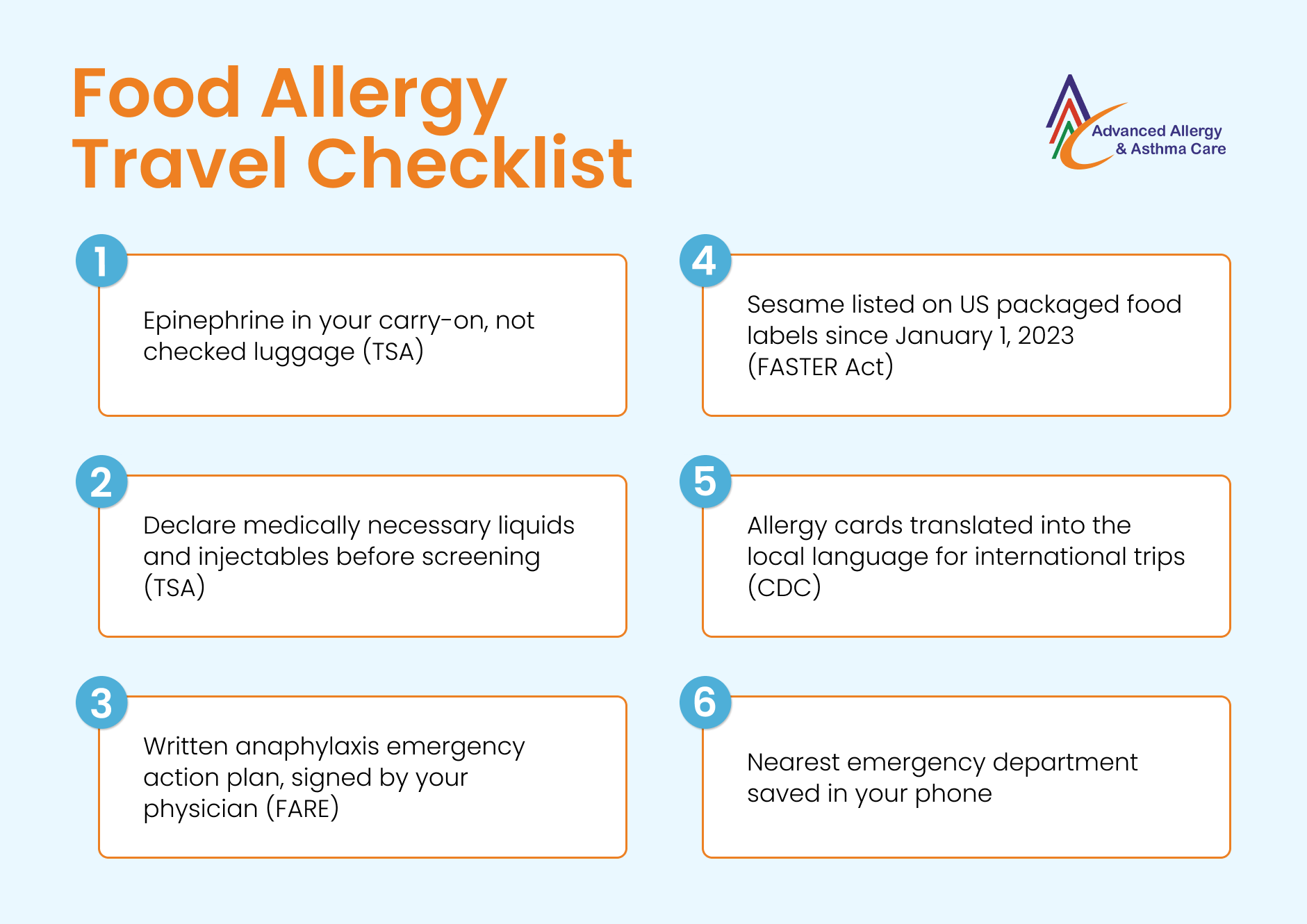
FARE recommends carrying a physician-signed emergency care plan if you’re traveling with food allergies, including emergency contact information. We also use these visits to confirm that auto-injectors haven't expired, the most common gap we find.
2. Carry epinephrine in your bag, not in checked luggage
TSA permits epinephrine auto-injectors in carry-on bags. Keep them with you rather than in the overhead bin or checked luggage, where temperatures may fall outside the medication's storage range. How many doses you carry is a conversation with your provider, not a blog rule of thumb.
3. Declare your medication at the security checkpoint
Medically necessary liquids and injectables are
exempt from 3-1-1 if you’re traveling with food allergies, but you need to remove them from your bag and tell the officer before screening starts. Keep devices in the original pharmacy carton with the label attached. It turns a conversation into a glance.
5. Ask about pre-boarding
The Department of Transportation has stated that passengers with severe nut allergies qualify for pre-boarding to clean their seating area. Worth knowing before you count on it: that right is currently tied to peanut and tree nut allergies specifically, as
FARE noted after the DOT's 2026 order. If your allergen is milk, sesame, or shellfish, ask the gate agent as a courtesy rather than assuming, since traveling with food allergies could require a little more precaution.
6. Pack your own food for the flight and the gaps
Bring more than you think you'll need. Delays, diversions, and closed airport kitchens are routine in late December. Shelf-stable food you have read the label on yourself is the only food on the plane you can fully account for.
7. Read labels regularly, even for products you buy weekly
Sesame became the ninth major allergen that must be declared on packaged food labels in the United States on January 1, 2023, under the
FASTER Act. Manufacturers reformulate; seasonal versions differ from the regular one, and holiday packaging often runs on a different line. Different countries can use different ingredients for similar products so reading labels becomes imperative if you’re traveling with food allergies.
8. Call restaurants before you visit
Ask for the manager, name the allergen, and ask how they handle cross-contact during a full dinner service. Mid-afternoon is a better time to call than 7 p.m. If the answer is vague, pick a different restaurant while you still have options.
9. For international trips, carry translated chef cards
When you travel internationally with food allergies, the risk is the language gap, not the cuisine. The CDC's travel guidance for
allergies abroad recommends bringing cards that list your allergies in the local language, plus copies of your allergy emergency plan in that language. Learn to say your allergen out loud too. Waiters remember a spoken sentence better than a card they hand back.
10. Know where care is available at all times
Find the nearest emergency department to where you are staying and save it in your phone. For international travel, check what your insurance covers abroad. This takes four minutes on the night you arrive, and people often forget it.
Get
food allergy testing if your diagnosis has never been confirmed or has not been reviewed in years at Advanced Allergy and Asthma Care.
What to Do If You Have an Allergic Reaction While Traveling
If you have an allergic reaction despite being careful, don't worry; stay calm first.
Follow the written plan your allergist gave you, use your epinephrine as prescribed, and get emergency medical help.
Symptoms of a severe reaction can involve more than one body system at once: hives or swelling, throat tightness, trouble breathing, vomiting, or dizziness. Our anaphylaxis overview walks through the signs in plain language.
Two things to know in advance. Reactions can return hours after the first one settles, so monitoring is important even after the patient feels better. The 2023 anaphylaxis practice parameter from the AAAAI notes that some anaphylaxis cases require more than one dose of epinephrine. Your provider will tell you what your plan should say about both.
If you’re on a plane, tell the flight crew immediately. Airlines carry medical kits, can reach ground-based physicians, and the crew decides whether to divert. You don't need to manage that decision while you are having a reaction.
Plan Your Holiday Travel With Advanced Allergy & Asthma Care
We see patients of all ages across five offices in New Port Richey, South Tampa, Pinellas Park, Dunedin, and Westchase. We often see patients traveling with food allergies. A pre-travel visit with us usually covers four things:
- Confirming or updating a food allergy diagnosis with allergy skin testing where it is appropriate
- Writing or refreshing your anaphylaxis emergency action plan
- Reviewing current prescriptions and expiration dates
- Talking through reactions to medications you might need while away, which is where drug allergy evaluation comes in
Testing confirms what you react to. It doesn't predict how severe the next reaction will be, and it doesn't affect how a restaurant in another country labels its food. Preparation lowers risk; it doesn't remove it.
Allergy symptoms also shift with hormones, sleep, and stress, which is part of
why allergies affect women differently at various stages of life. Holiday travel supplies all three.
Your Next Step Before the Trip
Pull out your auto-injectors tonight and check each expiration date. If any of them expire before you get home, or if you cannot find your written action plan, that is the appointment to make this month.
Book an Appointment with Advanced Allergy and Asthma Care, and our team will confirm a time at the office closest to you.
Frequently Asked Questions About Traveling With Food Allergies
How do I travel with food allergies for the first time?
Start with an allergist visit for current prescriptions and a written anaphylaxis emergency action plan. Keep epinephrine in your carry-on and declare it at security. Pack safe food for the whole journey, call ahead to restaurants and hosts, and locate the nearest emergency department at your destination before you need it.
Can I bring an EpiPen through airport security?
Yes. TSA permits epinephrine auto-injectors through security screening. Remove them from your bag, tell the officer before screening begins, and keep the devices in the original pharmacy carton with the label attached. Carry them in your personal item rather than checked luggage so they stay with you and at a stable temperature.
What should I know about traveling internationally with food allergies?
Allergen labeling rules differ by country, so a product you buy safely at home may carry different information abroad. The CDC advises carrying allergy cards and your emergency plan translated into the local language. Learn to say your allergen out loud, research hospitals near your accommodation, and confirm what your health insurance covers overseas.
Do airlines have to accommodate food allergies?
Airlines must offer pre-boarding to passengers who self-identify as needing extra time to board or be seated, and the Department of Transportation has recognized severe nut allergies under that provision. Buffer zone and snack-service policies vary by carrier, so check the airline's published food-allergy policy before booking.
Should I see an allergist before holiday travel?
A pre-travel visit is a good idea if your prescriptions are near expiration, your action plan is out of date, or your diagnosis has never been confirmed by testing. It is also worth it if your reactions have changed recently. Scheduling a few weeks ahead leaves time to fill prescriptions.
This article is for general education and is not medical advice. Talk with your provider about your own allergy diagnosis, medications, and travel plans.